Selling a Rental at $750K Income: When an Installment Sale Helps
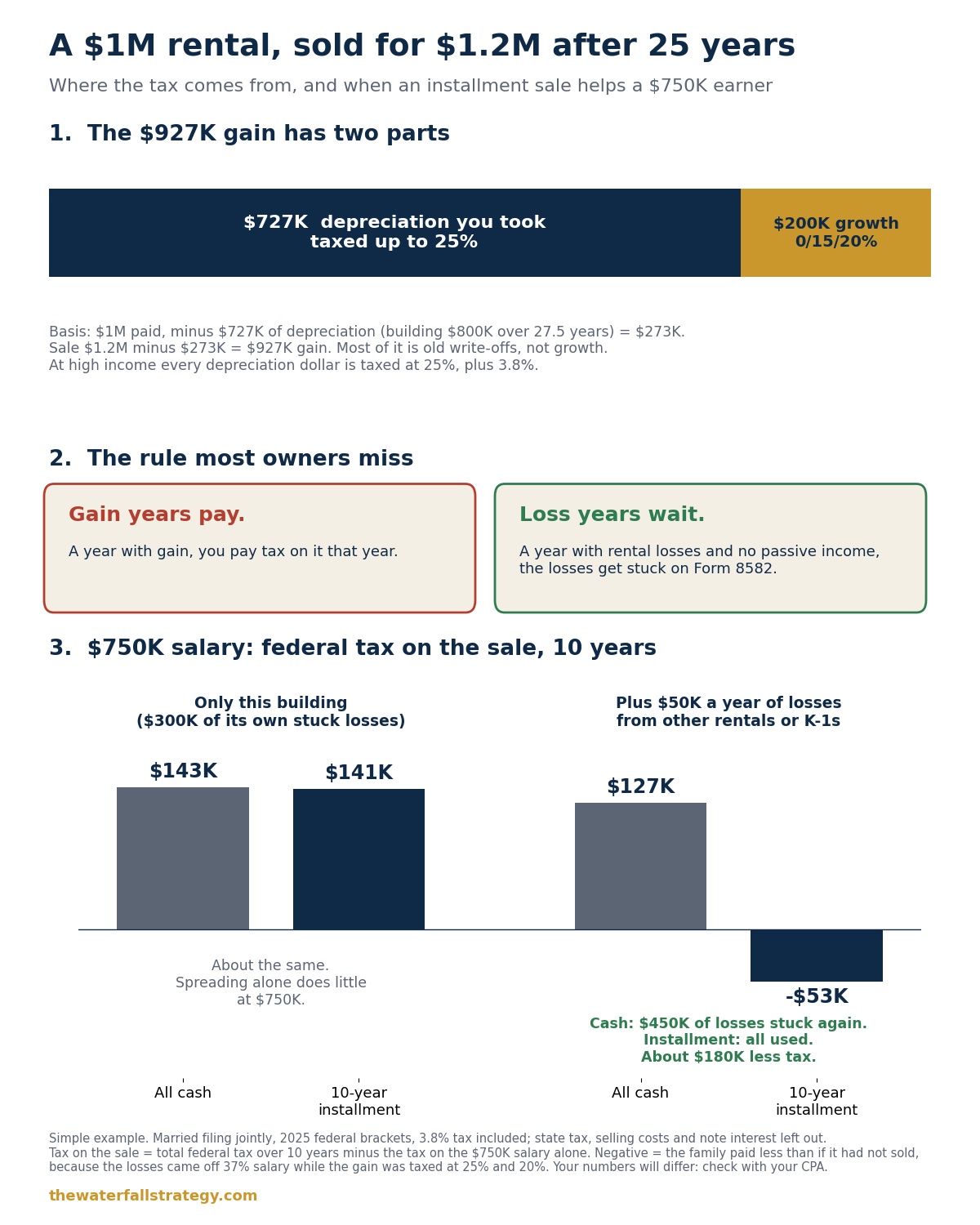
If you earn $750K a year and sell a rental you have held for 25 years, most of your gain is not growth. It is the depreciation you already deducted, taxed at up to 25%. An installment sale does not change that rate much at your income. What it can change is whether your rental losses get used or get stuck.
This page works one example from start to finish, with a picture, so you can see both sides.
Step 1: the gain
Here is the deal (simple example):
| Purchase price | $1,000,000 |
| Building share, 80% (land is never depreciated) | $800,000 |
| Depreciation, $800,000 over 27.5 years | $29,091 a year |
| Depreciation taken, 25 years | $727,273 |
| Adjusted basis | $1,000,000 minus $727,273 = $272,727 |
| Sale price | $1,200,000 |
| Gain | $927,273 |
The building went up $200,000. The gain is $927,273. The difference is the depreciation. Every dollar you deducted over the years lowered your basis, and it comes back as gain when you sell.
One note on a year the place sat empty, say during COVID: if it was still held out for rent, depreciation kept running that year too. Depreciation reduces your basis whether or not you claimed it ("allowed or allowable").
Step 2: two slices, two rates
| Slice | Amount | Federal rate |
|---|---|---|
| Depreciation you took (unrecaptured §1250 gain) | $727,273 | Your ordinary rate, capped at 25% |
| Growth, $1.2M minus $1.0M | $200,000 | 0%, 15% or 20% |
Then add the 3.8% net investment income tax once income passes $250,000 for a married couple, and your state. California taxes every slice as ordinary income.
At $750K of salary, you are already in the 37% bracket. So the depreciation slice is taxed at the full 25%, and the growth at 20%. That is true in a cash year, and it is true in each installment year.
Spreading alone has no lower bracket to reach. (Faster write-offs, like a cost segregation study, are worse: that part is taxed at ordinary rates up to 37%, in the year of sale, even on a note, §453(i).)
Step 3: gain years pay, loss years wait
This rule decides whether gain years can use loss years. The passive loss rules are a one-way street:
- A year with passive gain: you pay tax on it that year.
- A year with passive losses and no passive income: the losses do not touch your salary. They get stuck on Form 8582 and wait.
Gain from selling a passive rental is passive income (Temp. Reg. §1.469-2T(c)(2)(i)(A)). So the year the gain arrives is the year stuck losses can finally be used. And at $750K, a used loss comes off income taxed at 37%, while the gain it meets is taxed at 25% and 20%. That gap is why the tax on a sale can even come out negative.
Case A: only this building
Say the building itself carries $300,000 of stuck losses, and the owner has no other rentals.
| Federal tax on the sale, 10 years (simple example) | |
|---|---|
| All cash | about $143,000 |
| 10-year installment sale | about $141,000 |
About the same. A fully taxable sale frees the building's own stuck losses either way: all at once for cash, or a share each year on a note (§469(g)(3)). The rates are the same either way. Spreading saved about $2,500.
The note still defers tax, and that is worth something. But on rates alone, it does little for this owner. We say so plainly in 3 times an installment sale won't help.
Case B: plus $50K a year of losses that keep coming
Now the same owner also has $50,000 a year of passive losses from somewhere else, for 10 years: other rentals, K-1 deals, or a bigger building bought in a 1031. With income over $150,000, the small $25,000 rental allowance is gone, so those losses are stuck unless passive income shows up.
| Federal tax on the sale, 10 years (simple example) | Tax | Losses still stuck after 10 years |
|---|---|---|
| All cash | about $127,000 | $450,000 |
| 10-year installment sale | about negative $53,000 | none |
Take cash, and the gain meets one year of the new losses. Then the gain is gone, the losses keep coming, and $450,000 of them sit stuck again.
Take a 10-year note, and each year about $92,700 of gain arrives to meet that year's $50,000 of losses, plus a share of the building's own. Every loss gets used, against income taxed at 37%. About $180,000 less federal tax over the 10 years. Negative means the family paid less than if it had not sold at all.
That is the waterfall: time the gain to the losses.
The same rule after a 1031
This matters most after a 1031 exchange where you buy bigger and take some cash out. New money in a bigger building starts its own depreciation schedule (Reg. §1.168(i)-6), so the new building prints paper losses for years.
Take the cash out as one lump, and its gain is taxed in year one while the new losses pile up stuck. Take it in payments, and each year's gain meets that year's losses.
If your depreciation is already used up and no new losses are coming, there is nothing to absorb. Then this reason for an installment sale goes away.
What if your income drops?
If you will retire, the picture changes. Run the same Case A at $150,000 of income instead of $750,000, and spreading alone saved about $36,000, because each year's slice lands in the 10% to 24% brackets instead of 25%, and less of it crosses the 3.8% line (simple example). High earners who plan to stop working can time payments into those lower years.
What this example leaves out
- Interest. Any installment note pays interest, taxed as ordinary income every year. A cash seller would also earn something on the money.
- State tax. California adds up to 13.3% on all of it, with no lower rate for capital gains.
- Your actual losses. Read last year's Form 8582 before you decide anything. The size and timing of your losses drive this, not the sale price.
- Seller financing or a structured sale. The tax math is the same under §453 either way. The difference is who owes you and whether a buyer can pay early.
Bottom line
At $750K of income, an installment sale is not a rate play. It is a timing play for losses. If other passive losses will keep arriving, spreading the gain to meet them can save six figures. If they won't, cash and a note come out close.
Questions to ask your CPA
- How much of my gain is depreciation, and how much is growth?
- What is on my Form 8582 right now, activity by activity?
- What passive losses will my other rentals, K-1s or a 1031 replacement send each of the next 10 years?
- Will my income drop in a year I could time payments into?
- Did I ever do cost segregation, and how much of that comes back at ordinary rates?
Frequently asked questions
Does an installment sale lower my tax rate if I earn $750K?
Usually not by much. At that income the depreciation part of the gain is taxed at 25% and the growth at 20%, plus 3.8%, whether you take cash or payments. In our simple example, spreading alone saved about $2,500 of federal tax over 10 years.
Then when does it help a high earner?
When other passive losses keep arriving, from other rentals, K-1 deals or a bigger building bought in a 1031. Each year's installment gain is passive income that absorbs them. In our simple example that saved about $180,000.
What does gain years pay, loss years wait mean?
A year with passive gain, you pay tax on it. A year with passive losses and no passive income to meet them, the losses do not touch your salary; they get stuck on Form 8582 until a later year or a fully taxable sale.
Primary sources
- IRC section 1(h), capital gain rates (Cornell LII)
- IRC section 453 (Cornell LII)
- IRC section 469 (Cornell LII)
- IRS Topic 409, Capital gains and losses
- IRS Instructions for Form 8582
Authority pages checked November 22, 2026.
Educational only, not tax, legal or investment advice. Examples are illustrative. Have your CPA or tax attorney review your facts before you act.
Hans Goldstein is an Enrolled Agent, admitted to practice before the Internal Revenue Service, and a licensed insurance agent (CA Insurance License #4273294). He is not a CPA or attorney. He is paid a commission only if a structured installment sale is funded; seller financing pays him nothing. Disclosures.